

A port call is a sequence of movements, not a timestamp. How AIS positions, port zones and voyage history support arrival planning, live coordination and post-voyage review – and where they stop being reliable.
A port call is rarely a single arrival time. The vessel approaches, may wait at anchorage, enters the port, moves to a berth, completes its operation and departs. A change at any stage affects agents, terminals, fleet operators, charterers and service providers.
Port call monitoring uses live and historical vessel information to make that sequence visible. Done well, it follows the whole chain rather than a single arrival event, giving teams better situational awareness without pretending that a position feed is a guaranteed record of every operational milestone. That distinction matters commercially.
The sequence being monitored
A typical port call runs through approach, anchorage or waiting area, port entry, berth movement, in-port activity and departure. Each transition is a point where a plan can change and where somebody downstream needs to know.
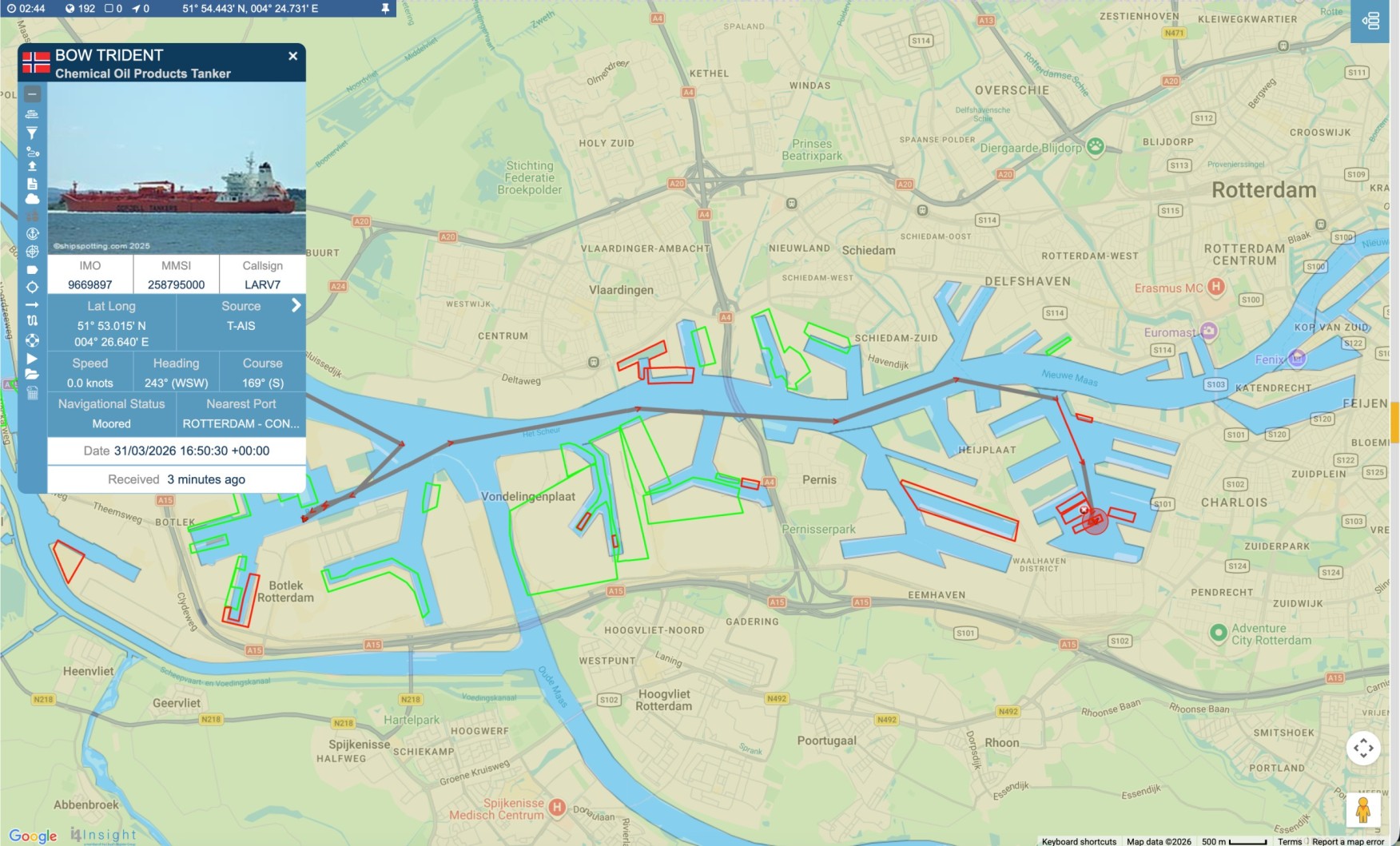
Not every port and vessel follows that pattern. Some calls involve multiple berths, offshore terminals, ship-to-ship activity or extended anchorage periods. Monitoring should use zones and rules suited to the local operation rather than applying one global definition of “arrived” to every port in the world. A mismatch here is one of the most common reasons automated port call data disagrees with what actually happened.
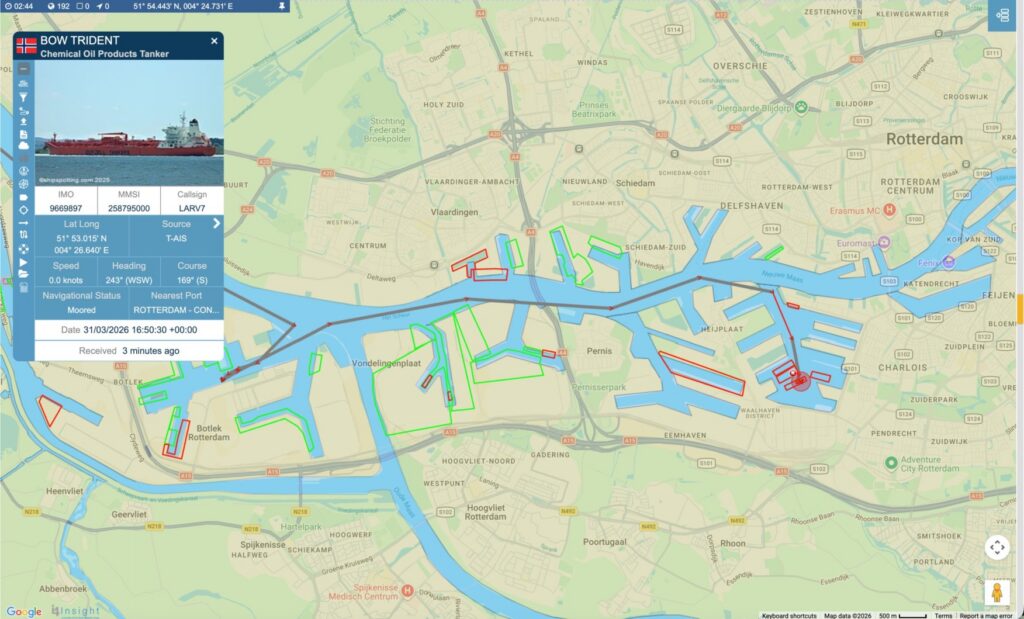
Berth-level zones in the Port of Rotterdam. Arrival is defined by the operation, not a single port circle.
What AIS can and cannot tell you
AIS provides vessel identity, position, course, speed and navigational status. Terrestrial receivers give dense coverage in coastal and port areas, where AIS port monitoring largely happens, while satellite AIS extends visibility into the approach voyage before the vessel reaches dense shore-based coverage.
When positions are combined with mapped port, anchorage and berth areas, a platform can identify approach, entry into an anchorage, arrival within port limits, movement between anchorage and berth, departure, extended dwell and changes in the expected sequence. These are the events worth surfacing, because they are the ones that change what somebody has to do next.
The approach is also where ETA matters most. The destination and ETA fields broadcast over AIS are entered manually and may be stale, inconsistent or out of date. Comparing them with the vessel’s actual position, speed and distance to go gives a more realistic arrival picture, and flags early when a reported ETA no longer holds. That is the core of good vessel arrival monitoring: checking the claimed arrival against the observed approach.
What AIS cannot tell you is why. It shows movement: not cargo operations, not the reason for a delay, and not the contractual meaning of an event.
The cost of hurrying up to wait
One of the most expensive patterns in shipping is also one of the easiest to see in AIS data. A vessel steams at full speed to reach port as early as possible, then sits at anchor for hours or days until a berth becomes free. Fuel consumption rises much faster than speed, so the extra knots on the approach cost a disproportionate amount of fuel and the time saved is simply spent waiting.
The bill is paid several times over: higher bunker costs, hire or operating costs for days with no productive work, additional CO2 and other emissions, and more crowded anchorages close to port communities. For vessels subject to the Carbon Intensity Indicator (CII), fuel consumed while waiting can worsen attained carbon intensity, because it adds emissions without adding transport work.
Commercial terms often encourage the behaviour. Where the charterparty makes contractual arrival and a valid notice of readiness prerequisites for laytime, there can be an incentive to reach the waiting place early, even when the berth is not ready. Just-in-time arrival initiatives, promoted by the IMO and a growing number of ports, and contractual mechanisms such as virtual arrival aim to change this by agreeing a realistic arrival time early enough for the vessel to adjust speed.
Port call monitoring makes the pattern measurable. Historical port activity shows how long vessels typically wait at a given anchorage and how approach speed compares with waiting time. Live monitoring shows when a nominated vessel is racing towards a port that is already congested. That evidence supports better conversations between operators, charterers, agents and terminals about speed, ETA and berth planning. AIS cannot renegotiate a charterparty, but it can show exactly where the time is going.
Who uses it, and for what
Fleet and voyage operations
Follow owned or managed vessels, compare actual movement with the voyage plan, and spot disruption around arrival or departure early enough to respond.
Ship agency and service coordination
Timely entry, anchorage and departure alerts help agents coordinate pilots, tugs, crew changes, stores and surveys – with local confirmation before committing to critical arrangements.
Port and terminal planning
Monitor expected arrivals and anchorage activity, and use historical patterns to review congestion, turnaround performance and recurring bottlenecks.
Commercial and market intelligence
Use port activity, combined with vessel characteristics and voyage history, to understand trading patterns, vessel availability and market behaviour.
Insurance, security and incident review
Establish whether a vessel called at a port, waited at anchorage, changed route or was near an incident, using historical movement as a timeline to guide further evidence gathering.
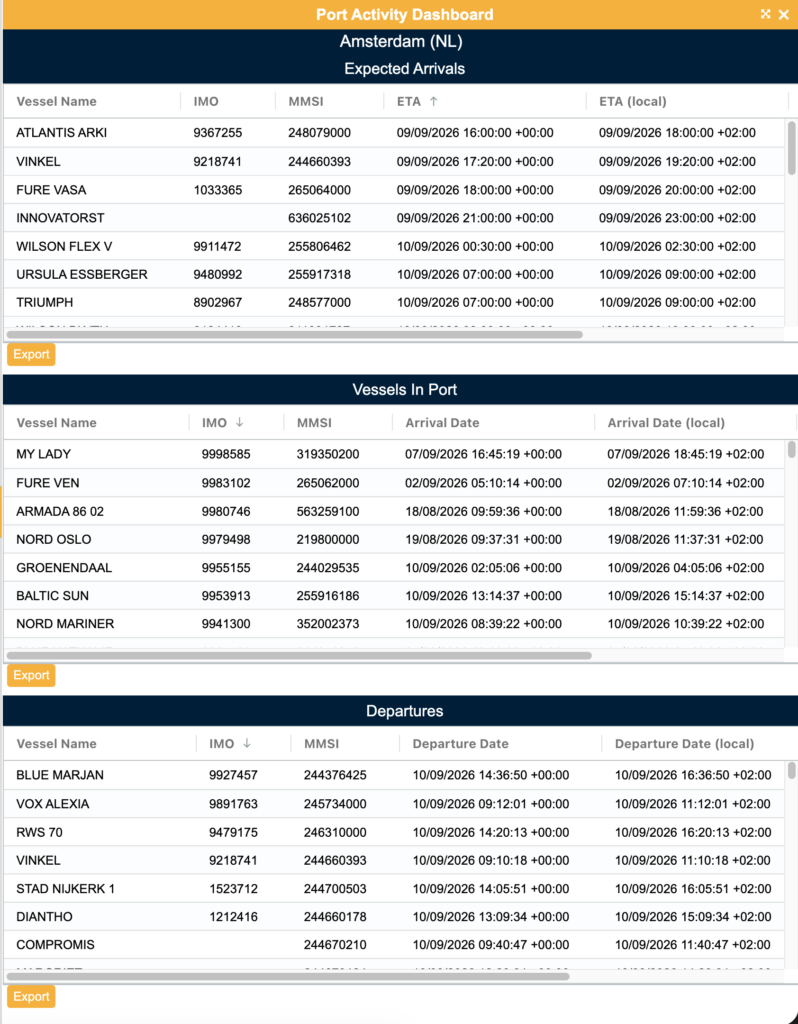
Port activity for Amsterdam: expected arrivals, vessels in port and departures in one view.
Alerting without drowning the team
Ports generate constant routine movement. Alerting on every boundary crossing becomes unmanageable within days, so monitoring rules should follow operational responsibility rather than curiosity.
The alerts that tend to earn their place are these:
- A nominated vessel enters the port approach zone.
- A nominated vessel is steaming at high speed towards a port where the anchorage is already congested.
- An expected arrival has not reached the anchorage by an agreed time, or its reported ETA no longer matches its observed approach.
- A vessel remains at anchor beyond an agreed waiting threshold.
- A vessel departs the berth or port area.
- A monitored vessel enters an unexpected port.
- A vessel changes status within a terminal zone.
- A reporting gap occurs during a security-sensitive part of the call.
Vessel departure alerts are especially useful when downstream planning depends on knowing that the vessel has actually cleared the berth or port area.
Each should be routed to the team that owns the response and paired with a clear next step. An agent may need to contact the master or terminal, an operator may revisit the voyage plan, a security team may review the wider movement context. An alert with no owner is noise with a timestamp.
Related: Vessel geofencing and AIS alerts
What historical port activity reveals
Live monitoring serves today’s operation; history serves analysis, reporting and improvement. Reviewing previous calls shows typical approach and anchorage patterns, waiting time before berth, in-port duration and turnaround trends, recurring congestion at particular times or locations, differences between vessels, terminals or routes, and the sequence of events around a disputed delay.
Used this way, history turns anecdote (“that port is always congested in March”) into evidence that can inform voyage planning, speed instructions and commercial terms.
The limitation that costs money
Observed movement and contractual events are different things. When a vessel crossed a port boundary is a matter of position data. When notice of readiness was tendered and accepted, when laytime commenced, and whether the vessel was an arrived ship in the contractual sense depend on the applicable charterparty terms and documented record. AIS can inform a laytime discussion and provide a useful timeline. It does not settle one.
Other limitations are more mundane but just as consequential:
- Destination, ETA and navigational status fields are entered manually and are often inaccurate or stale.
- Position reports can arrive at irregular intervals, with reception gaps offshore and message loss in very busy port areas where many transponders share the same channels.
- Complex port boundaries cannot be represented by a simple circular zone, and a single call may involve several berth movements.
- Transponders are sometimes switched off – occasionally for legitimate security reasons – and positions can be deliberately manipulated.
- Not every vessel is required to carry AIS.
That last point needs care. Under SOLAS, AIS is mandatory for ships of 300 gross tonnage and upwards on international voyages, cargo ships of 500 gross tonnage and upwards on domestic voyages, and all passenger ships. The bulk carriers, tankers, container ships and gas carriers that most port call monitoring is concerned with are therefore required to carry it. The gaps are among smaller craft – some fishing vessels, workboats, harbour craft and leisure vessels – which may carry lower-power Class B units or no AIS at all, depending on flag and local rules. That rarely affects tracking a nominated vessel, but it matters when reviewing anchorage activity or an incident involving smaller craft.
A platform that presents an automated event label without letting you inspect the underlying track is asking for trust it has not earned.
Related: What happens when a vessel disappears from AIS?
Building a workflow that holds up
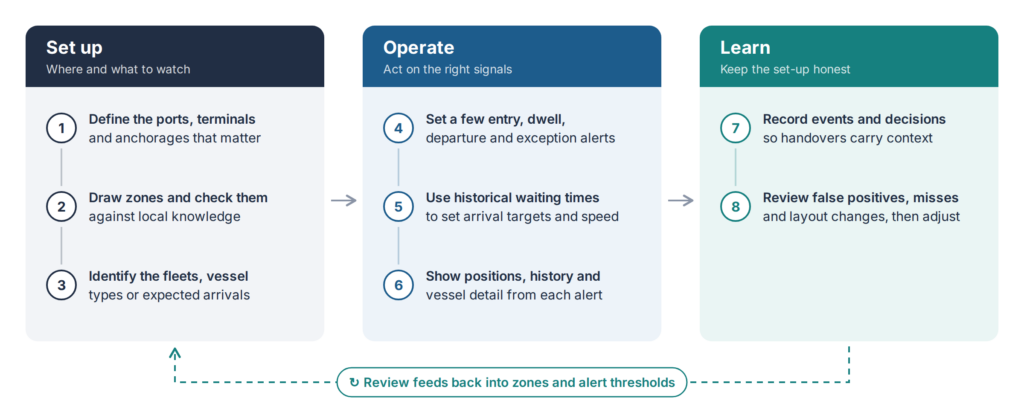
- Define the ports, terminals and anchorages that actually matter to the organisation.
- Draw accurate zones and check them against local operational knowledge, not just a chart.
- Identify the fleets, vessel types or expected arrivals to be monitored.
- Set a small number of meaningful entry, dwell, departure and exception alerts.
- Use historical waiting times to set realistic arrival targets and speed instructions, rather than defaulting to “arrive as soon as possible”.
- Give users live positions, voyage history and vessel detail directly from the alert.
- Record key events and decisions so a handover carries context, not just status.
- Review false positives, missed events and changed port layouts, then adjust.
The steps fall into three phases (set up, operate and learn), and the last one feeds back into the first.
In BigOceanData, port and anchorage zones, vessel alerts, live positions and historical voyage replay sit in the same operational view, so an alert can be checked against the underlying movement rather than treated as an isolated timestamp.
Frequently asked questions
What is port call monitoring?
Port call monitoring is the process of following a vessel’s progress before, during and after a port visit: approach, anchorage, port entry, berth movement, in-port activity and departure, using live positions, mapped zones and voyage history.
Can AIS confirm when a vessel arrived for laytime purposes?
No. AIS shows observed movement and provides a useful timeline, but contractual arrival, notice of readiness and laytime commencement depend on the applicable charterparty terms and documented records rather than position data alone.
Why do automated port call times sometimes disagree with the agent?
Often because a generic port boundary does not match local operation, or because a call involved multiple berths, an offshore terminal or ship-to-ship activity. Zones should be drawn against local knowledge rather than applying one definition globally.
How much port history is useful?
Enough to establish seasonal and trend patterns rather than a single snapshot. For seasonal patterns, a full year is a useful starting point; longer windows provide a stronger basis for congestion benchmarking or reconstructing the events around a disputed delay.
Can port call monitoring help reduce fuel use and emissions?
Yes, indirectly: by exposing anchorage waiting times and vessels racing towards congested ports, it gives operators and charterers the evidence to agree slower, just-in-time arrivals.
Do all vessels have to carry AIS?
No. Commercial merchant ships above the SOLAS size thresholds must carry it, but many smaller craft do not, or carry lower-power Class B units.
A clearer view of the whole call
Port call monitoring is most useful when it connects the voyage, the port and the historical picture. The approach gives early awareness, port and anchorage zones show progress and waiting time, alerts highlight exceptions, and voyage replay explains the sequence afterwards.
It reduces manual checking, exposes the fuel and emissions cost of arriving early only to wait, and gets the right people looking at the same movement context. It does not replace local port information or operational confirmation – and it works best when everyone treats it as shared evidence rather than the final word.
See how one of your own port calls looks in BigOceanData.
Review the approach, anchorage wait, berth movement and departure in one timeline.
Book a demo | Explore vessel tracking | Explore maritime intelligence